

Well, for years and years both mathematics and statistics were against us: we saw bleachers being built along the Bay Street throughout December. We read in all tourist pamphlets that it is about to happen. And then we saw the bleachers dismantled. And for the rest of the year we saw the name Junkanoo on everything from t-shirts to cocktails to the name of Nassau city beach so we ended up thinking it was some marketing trick.
Finally the New Year of 2014 was off to a very colorful, loud and exotic start: we spent some the first hours of the New Year in Nassau watching Junkanoo!
Despite the fact that Junkanoo is a cornerstone of Bahamian culture it is still quite unclear where the word itself comes from. Some say it comes from French 'gens inconnus' (unknown people) as the faces were hidden. While most believe it comes from the name John Canoe, an African prince and slave trader that operated in XVII century. Legend has it that he outsmarted the English which made both the English and Dutch fear him. Of course, such a persona was idolized by slaves, they considered him a hero and worshiped, even after being transported to the Bahamas.
Back then the slaves were only allowed 3 days off during the year: January 1st, December 25th & 26th. These were the only days when the slaves could leave the plantations and go home. And while Christmas was the day of rest for the families, December 26th and January 1st were the days to perform their Junkanoo celebration.

After the emancipation the tradition almost vanished - everyone was free to do whatever wherever , not just 3 days a year.
Luckily for us, tourists, in the 1920’s the authorities decided to commercialize Junkanoo and the festival was held on Bay Street for the first time. In the 50’s the parade became more organized as categories were introduced and groups representing different districts were formed. Until now it is a competition between the groups where the prize money – according to our Bahamian friend – is used to throw a party for the winning group. So even though now Junkanoo has become a tad more commercial – with sponsors and prize money – people are not in it to win a million. It is a fun and colorful competition that takes almost a year to prepare and where everyone – no matter age, height or weight – can take partake.
Luckily for us, tourists, in the 1920’s the authorities decided to commercialize Junkanoo and the festival was held on Bay Street for the first time. In the 50’s the parade became more organized as categories were introduced and groups representing different districts were formed. Until now it is a competition between the groups where the prize money – according to our Bahamian friend – is used to throw a party for the winning group. So even though now Junkanoo has become a tad more commercial – with sponsors and prize money – people are not in it to win a million. It is a fun and colorful competition that takes almost a year to prepare and where everyone – no matter age, height or weight – can take partake.
 |
| Junkanoo truly knows no restrictions... |
 |
| ...gathering old, young and even very young. |
The new material that was added in the 30's was the sponge - believe it or not the sponging was then the main industry of the Bahamas (now it is tourism and banking and we are not sure whether any amount of sponge is still produced).
Today the costumes are made of six main materials: cardboard, crepe paper, aluminum rods, wire, contact cement and glue. The finishing touches are done with glitter, feather and decorative beads. An average costume requires three to five thousand of multi-colored crepe paper for competition and entry into Junkanoo parade. Tradition calls for absolute minimal use of cloth to make costumes.

The shape of costumes changed too: instead of shirt and trousers shoulder pieces and skirts made of cardboard and fringe paper were introduced. Later on different groups looking for more creative materials started using cloth and chicken coop wire that allowed some movement for the costumes.

Each group starts with a huge centerpiece: a float that defines the theme.
 |
| The lead costume dragging the float |

 |
| These guys probably represents Puerto Rico |
 |
| This is probably Puerto Rico rendered by another group |
 |
| This is must be Louisiana... |


 |
| Try to dance in this one, especially with +30C on the thermometers... |
Free dancers are followed by the back lines: the musicians.
Music is not less important part of Junkanoo than the costumes. It started with all sorts of drums that created that infectious pulse or beat and definitely derive from African tradition. First drums were made from wooden barrels with cured goat or sheep skin (you will be surprised but they do have sheep in the Bahamas!), stretched and nailed on one end leaving the other end open. Now the drums of all shapes and sizes are used along with scrapers, horns and whistles.
The tradition of using barrels has also survived only now they used metal oil barrels. The biggest ones are affectionately called B-52’s or Rocket Launchers, They are carried under one arm supported by a thick strap that runs across the opposite shoulder of the drummer who plays with his bare hands. The B-52’s are now an important part of the back line brining more bass.
 |
| Even within one group you can see both plastic and sheep-skin drums |
 |
| Now try to carry this one around while beating and dancing (and do not forget about +30C). |


Over the years unusual types of horns were introduced – foghorns usually installed on the boats and bicycle horns that are usually doubled or tripled for a louder sound effect.
 |
| This one is not just doubled or tripled, what's the word for 8 times multiplication? Octo'ed? |
 |
| Even referee whistle can do. |

Another important, loud and colorful part of the back lines are scrappers that create a mix of noises and cacophony using washboards and spoons, sticks, bottles, nails, saws and screwdrivers.

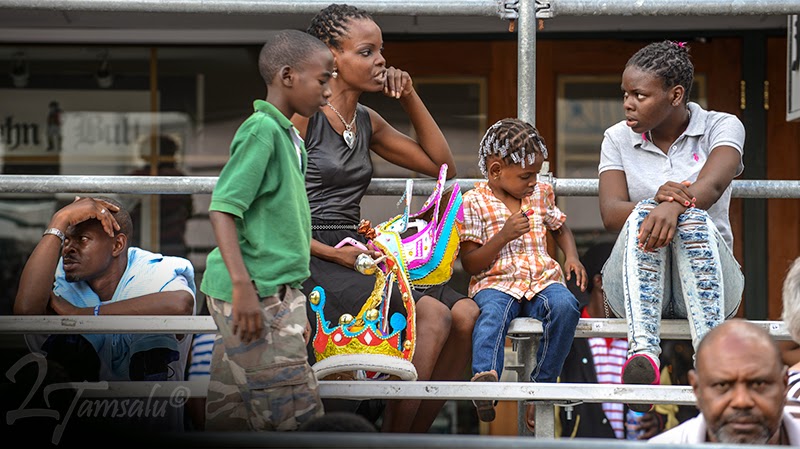
The local families gather on the bleachers and the spectators also look the part wearing Junkanoo hats or simply bright colorful outfits.

Even the police - though they try to keep a straight face - seem to be moving in the beat.

The Junkanoo parade normally begins at midnight on Boxing Day and New Year’s Day on the Bay street and lasts all night. We were there between 10am and noon and the parade was still on, only the bleachers were getting emptier.
It is must be really difficult for the panel of judges to decide on the best group or costume. But once the decision is made and the party for the winners is thrown, the Junkanooers get together again and starting planning the next year parade.

P.S. If you do not happen to be in Nassau on one of the two Junkanoo days there is another way to partake: make a James Bond movie. One of the episodes of Thunderball was filmed here and even though the filming was done on the wrong time of the year, the locals were so enthusiastic so help that they made costumes and 'staged' the parade. So grab Daniel Craig, show up in Nassau and - who knows - this might work one more time!
It is must be really difficult for the panel of judges to decide on the best group or costume. But once the decision is made and the party for the winners is thrown, the Junkanooers get together again and starting planning the next year parade.
P.S. If you do not happen to be in Nassau on one of the two Junkanoo days there is another way to partake: make a James Bond movie. One of the episodes of Thunderball was filmed here and even though the filming was done on the wrong time of the year, the locals were so enthusiastic so help that they made costumes and 'staged' the parade. So grab Daniel Craig, show up in Nassau and - who knows - this might work one more time!
<<<<Previous post Next post >>>>


