Showing posts with label Caribbean. Show all posts

Tuesday, February 25, 2014

Junkanoo in the Bahamas


Olympic Games happen ones every four years. Venetian Biennale – once in two years. Super Bowl – every year. Junkanoo in Nassau takes place twice a year. We have not been to the Olympics but have been in Venice during Biennale and New Orleans during Super Bowl. No wonder that visiting Nassau regularly we were hoping that we had a mathematical and statistical probability of seeing it.


Well, for years and years both mathematics and statistics were against us: we saw bleachers being built along the Bay Street throughout December. We read in all tourist pamphlets that it is about to happen. And then we saw the bleachers dismantled. And for the rest of the year we saw the name Junkanoo on everything from t-shirts to cocktails to the name of Nassau city beach so we ended up thinking it was some marketing trick. 

Finally the New Year of 2014 was off to a very colorful, loud and exotic start: we spent some the first hours of the New Year in Nassau watching Junkanoo!

Despite the fact that Junkanoo is a cornerstone of Bahamian culture it is still quite unclear where the word itself comes from. Some say it comes from French 'gens inconnus' (unknown people) as the faces were hidden. While most  believe it comes from the name John Canoe, an African prince and slave trader that operated in XVII century. Legend has it that he outsmarted the English which made both the English and Dutch fear him. Of course, such a persona was idolized by slaves, they considered him a hero and worshiped, even after being transported to the Bahamas.

Back then the slaves were only allowed 3 days off during the year: January 1st, December 25th & 26th. These were the only days when the slaves could leave the plantations and go home. And while Christmas was the day of rest for the families, December 26th and January 1st were the days to perform their Junkanoo celebration.


After the emancipation the tradition almost vanished - everyone was free to do whatever wherever , not just 3 days a year.

Luckily for us, tourists, in the 1920’s the authorities decided to commercialize Junkanoo and the festival was held on Bay Street for the first time. In the 50’s the parade became more organized as categories were introduced and groups representing different districts were formed. Until now it is a competition between the groups where the prize money – according to our Bahamian friend – is used to throw a party for the winning group. So even though now Junkanoo has become a tad more commercial – with sponsors and prize money – people are not in it to win a million. It is a fun and colorful competition that takes almost a year to prepare and where everyone – no matter age, height or weight – can take partake.

Junkanoo truly knows no restrictions...
...gathering old, young and even very young.
When the slaves were first brought over from Africa they made costumes the way they were used to: collecting shrubs, leaves, stones, bottles and paper.
The new material that was added in the 30's was the sponge - believe it or not the sponging was then the main industry of the Bahamas (now it is tourism and banking and we are not sure whether any amount of sponge is still produced).
Today the costumes are made of six main materials: cardboard, crepe paper, aluminum rods, wire, contact cement and glue. The finishing touches are done with glitter, feather and decorative beads. An average costume requires three to five thousand of multi-colored crepe paper for competition and entry into Junkanoo parade. Tradition calls for absolute minimal use of cloth to make costumes.


The shape of costumes changed too: instead of shirt and trousers shoulder pieces and skirts made of cardboard and fringe paper were introduced. Later on different groups looking for more creative materials started using cloth and chicken coop wire that allowed some movement for the costumes.


Each group starts with a huge centerpiece: a float that defines the theme.

The lead costume dragging the float
This year we could decipher Biblical topics; representation of each of the United States; American history with cowboys and Indians, Abraham Lincoln and other father founders in white curled wigs; modern American society with tea party, obamacare and Michael Jackson. There was even a giant Statue of Liberty whose torch was broken, was it an accident or intended political symbolism? We could not figure it out.


These guys probably represents Puerto Rico
This is probably Puerto Rico rendered by another group
This is must be Louisiana...
The platform is followed by free dancers, the front liners of every group: their costumes are smaller allowing for more movement. Their dance used to be an improvisation with traditional African pelvic shaking moves but now the routines are thoroughly rehearsed and even professional choreographers and dancers are invited.


Try to dance in this one, especially with +30C on the thermometers...

Free dancers are followed by the back lines: the musicians.

Music is not less important part of Junkanoo than the costumes. It started with all sorts of drums that created that infectious pulse or beat and definitely derive from African tradition. First drums were made from wooden barrels with cured goat or sheep skin (you will be surprised but they do have sheep in the Bahamas!), stretched and nailed on one end leaving the other end open. Now the drums of all shapes and sizes are used along with scrapers, horns and whistles.

Even within one group you can see both plastic and sheep-skin drums
The tradition of using barrels has also survived only now they used metal oil barrels. The biggest ones are affectionately called B-52’s or Rocket Launchers, They are carried under one arm supported by a thick strap that runs across the opposite shoulder of the drummer who plays with his bare hands. The B-52’s are now an important part of the back line brining more bass.

Now try to carry this one around while beating and dancing (and do not forget about +30C).
It the 70’s the brass section was introduced and now it grew to be an integral part of Junkanoo music using locally produced instruments.


Over the years unusual types of horns were introduced – foghorns usually installed on the boats and bicycle horns that are usually doubled or tripled for a louder sound effect.

This one is not just doubled or tripled, what's the word for 8 times multiplication? Octo'ed?
Even referee whistle can do.
Another unusual instrument: the conch shell, the most traditional horn taken from the sea mollusk Strombus Gigas. Conch is also a staple of Bahamian cuisine being served raw, steamed, deep fried (more in Bahamian food later).


Another important, loud and colorful part of the back lines are scrappers that create a mix of noises and cacophony using washboards and spoons, sticks, bottles, nails, saws and screwdrivers.


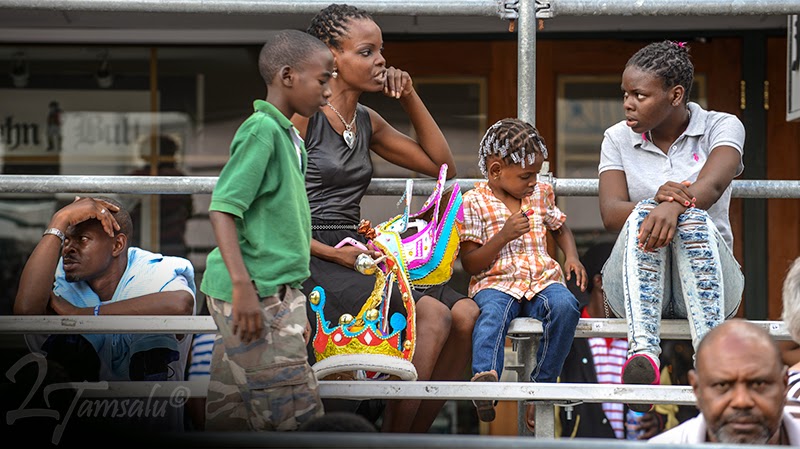
The local families gather on the bleachers and the spectators also look the part wearing Junkanoo hats or simply bright colorful outfits.


Even the police - though they try to keep a straight face - seem to be moving in the beat.


The Junkanoo parade normally begins at midnight on Boxing Day and New Year’s Day on the Bay street and lasts all night. We were there between 10am and noon and the parade was still on, only the bleachers were getting emptier.
It is must be really difficult for the panel of judges to decide on the best group or costume. But once the decision is made and the party for the winners is thrown, the Junkanooers get together again and starting planning the next year parade.


P.S. If you do not happen to be in Nassau on one of the two Junkanoo days there is another way to partake: make a James Bond movie. One of the episodes of Thunderball was filmed here and even though the filming was done on the wrong time of the year, the locals were so enthusiastic so help that they made costumes and 'staged' the parade. So grab Daniel Craig, show up in Nassau and - who knows - this might work one more time!


<<<<Previous post                Next post >>>>

Saturday, March 16, 2013

Kohunlich: where the cohune palms grow

Costa Maya is a developing cruise ships stop in Southern Quintana Roo state of Mexico. The port itself is a tourist trap - a sort of village Disney would built if he were Mexican: there are thatched roofs and big pool with swim-in bar, there are dancing Maya and Maya playing ulama (traditional ball game), there are puppy lion and puppy tiger, there are dolphins, there are two popular Mexican eating franchises deafening everyone with blaring music and exclaiming MCs and to top this off - dozens of shops selling silver, leather, diamonds, tequila, making henna tattoos & weaving bracelets. 
We are not fans of things made specifically for tourists - we work on one such thing - and try to find either cute local places or historical monuments. Costa Maya offers both.
Just half hour walk (or 5 minutes by cab) away there is a local village of Mahahual with sandy beach, thatched palapas, a handful of bars and restaurants and very affordable beach massage under the palm trees.
There is something for history buffs too as a few important and a little less known Maya sites lay inland. For those who want to see the ruins the choice is usually between Chaccoben & Kohunlich.
Chaccoben is closer - about an hour drive from the port - which gives you an opportunity to either take a 4-hour tour and leave time for tiger & henna tattoos or combine it with a beach thus making it a 6 hour trip. 
Kohunlich (pronounced Koe•hoon•leech) is farther away: the drive takes more than 2 hours so the entire tour will last 6 hours and you will have no time for shopping and strolling. So if you are a shopper, family with small kids or cannot take 2 hours on the bus - opt for Chaccoben, Kohunlich is recommended only for hardcore Maya fans.
We chose Kohunlich as Chaccoben only offered several pyramids while Kohunlich was elaborately planned and engineered, with raised platforms and pyramids, citadels, courtyards, a ball court and central plaza fringed by pyramids, temple platforms and  stands for the spectators of religious ceremonies. But the real gem is a Temple of the Masks (also called Building of Figureheads). So, it is decided - we are going to Kohunlich.
After 2 hours drive we step into the Mayan site (mind it, it is really in the middle of nowhere and during almost two hours on the site there will be no toilets or ice cream vendors so grab your bottle of water (usually provided by the tour company) and take care of your 'business' at the entrance.
Speaking of tour companies. As much as we like to travel independently - and there is a bunch of taxi drivers offering to take you there - Maya site is one place you definitely want to visit with a guide. Without the narration about Maya culture and history it is just a pile of old rocks.
The site opens up by an enormous plaza surrounded by pyramids, acropolis and craftsmen's quarters. What is today a mowed green lawn at Maya times was covered with 'Maya cement' - mixture of burnt and crushed limestone with water and crushed seashells traded from coastal communities. 


All over the site you can see giant cohune palms that actually gave the modern name to the city. Despite the fact it sounds very 'Mayan' to our ear, it comes in fact from English expression  Cohune Ridge 'where cohune palm grew'. The Maya distorted English words in their way thus forming the name Kohunlich. In modern Maya it is called X-làabch'e'en but no one knows what it was called at its prime.

Cohune palms in Kohunlich

To the left - ruins of the palace. At the moment it does not really look up to royal living standards but at the time it was considered an elegant residence for Kohunlich higher society. Nowadays not much of the structure remains with trees and plants being its new inhabitants.


The next structure - Acropolis - attracts your attention by its staircase. Imagination starts working vividly, memory brings up the fragments of movies as you think of all the human sacrifices most probably commissioned here. This is true: Maya along with other Mezoamerican civilizationals were fond of Human sacrifices and came up with several elaborate ways : along with decapitation that is more usual for Europeans, Maya  also practiced opening chest and offering heart to gods, throwing down from the pyramid...


General public believe that all pre-Columbian architecture consists of pyramids but this is not true: apparently Maya built different types of structures - temples, ceremonial platforms, stands for the spectators, observatories and even multi-level living quarters. Multi-stores buildings were possible due to the invention of so called 'Maya arch' that supported structure and weight above it. But unlike in European arch with voussoirs directed radially and locked with keystone all rocks in Maya arch are laid horizontally. This requires the walls to be much thicker and made the rooms very long and narrow as they were basically elongated arches (Maya vault).


In Northern cultures most important things happen indoors: most of the year the weather does not cooperate. Just compare the the Southern carnival with the Northern ball. In Maya culture - until nowadays - main things happen outdoors with living quarters being rather small and basic. Ancient Maya were no exception: just look at the room in one of the living quarters and the Mayan bed...


Pixa'An residential compound 
Maya bed: the niches under the bed and in the walls were used to store things 
Religious ceremonies and public events were far from being humble: until now the heart of Kohunlich is an enormous plaza flanked with temples and the bleachers for the spectators:

Maya bleachers
The temples during the classic period had east-west orientation. The temples oriented to the east were used for religious ceremonies connected to birth whilst those oriented to the west - naturally those connected to death. But do not ask how to determine an orientation of the pyramid, one has to be a big Maya connoisseur to do that!

El Rey - Temple of the King
An amazing thing about Maya is that they abandoned their cities and then reoccupied them centuries later. Be it a drought, a war or en epidemic the citizens would leave the place and venture elsewhere. Centuries later another group of Maya that had abandoned their city would accidentally stumble upon a city in the jungle. They would clean it up and reoccupy. To celebrate their superiority they would build a bigger temple... by simply constructing it atop older ones. Or it could be a vanity of a new ruler. This is why most Maya pyramids have understructures: layers and layers of older buildings underneath, some up to 20.
If you look closer you can see the layers of older structures coming out:


With all due to respect to Maya in European history it was not common to leave the cities: after plagues, floods and wars people kept coming back and rebuilding their home towns. It took a volcano eruption to destroy Pompeii and Herculanum. As abandoning cities used to be a habit of Maya there could still be sites out there. For example, Kohunlich was only discovered in 1969 and Chacobben (also located next to Costa Maya cruise ship port) was only discovered in 1972 when an American archaeologists noticed from a helicopter an abundance of hills in predominantly flat area. Each hill turned to be a pyramid.
As to Kohunlich,  it was built in the early VI century, abandoned in the XII century and never re-occupied.  


Thanks to the recent buzz about 'Mayan Apocalypse' now everyone knows about Maya's keen interest in time-keeping and calendars. Usually calendars were prominently displayed in the places of public ceremonies - such as Plaza of the Stelae. 


Most probably this is where the calendars were displayed


But the real gem of Kohunlich is the Temple of the Masks. At some point there were 8 of them - 4 from each side flanking the staircase. But Maya's habit of covering previous structure with new temples atop the old ones actually helped to preserve the masks: this temple was also covered over, which protected the masks for the marvelous state of their preservation today.
Unfortunately - even though the site was unknown till the 60's of the XX century - apparently some locals knew (or guessed) that the lush hill conceals an ancient structure and one of the masks was looted.
Paradoxically, this looting actually helped discover the site as one of the local peasants noticed the site being vandalized and reported to local authorities. It has since been protected by Mexican National Heritage.
Another mask is still hidden under a protective layer - for future generations. 

Temple of the Masks - right flank, in the bottom - masonry covering the fourth mask
Temple of the Masks - left flank

Maya art was very symbolic and this is where a good guide comes in. Of course, you can still admire the beauty of the carving but you will never guess that for example the strokes and dashes in the eyes are in fact references to symbol kin - that could mean day, sun and time.


Or how would you know why many masks have jaguar's head underneath?
Well, according to Maya mythology the world was multi-layered. The Middleworld, the world of living consisting of 4 levels; above it lays the bright and sunny Upperworld with 13 gods and 13 layers (hens the number of months in Tzolk'in, Maya religious calendar), below us the wet & dark Underworld, world of dead ruled by 9 gods and consisting of 9 levels. 
Maya kings and priests (it was a theocratic society so the administrative and military ruler was also the main priest) were associated with sun. But as the sun dies and is reborn every day it must go through the unpleasant underworld where it is accompanied by jaguar representing the world of dead. This is why jaguar has such a spiritual significance in Maya culture.


It is believed that the masks depict the sun god Kinich Ahau however they differ in appearance so it is thought that they also represent the various rulers of Kohunlich. Or maybe they represent rulers in the form of the Kinich Ahau.


Some masks still preserved their original red color - color of sun on sunset (by the way, masks are directed to face the sunset). Red color was made from cochineal insect (traded from Central Mexico) and painted 'al-fresco' on top of wet cement.


It is hot and steps are steep but if you climb up and wait for your turn you will be awarded  by amazingly intricate details carved on them. It is even more amazing taking into consideration the fact that Maya did not know metal and all the carving and polishing was done using obsidian traded from Guatemala and Mexican state of Chiapas.


Even though the excavations began immediately after its re-discovery in 1969 two-thirds of the area is still buried.  


One of the great things about Kohunlich was the freedom to explore and climb the structures compared to other Maya ruins in the area (famous Tulum being of them).  It was a pleasure to explore the site imagining it in the days of its grandeur.
Was it worth the long, four-hour round trip bus ride? For us - absolutely yes. We received wealth of info on Maya, the opportunity to climb and explore the structures and photograph the amazing masks up-close. The park-like setting with green lawns and cohune palms made a great impression. 


Last look at Kohunlich...


Despite the fact that we came here to admire architectural monuments,  local flora was not less interesting. Aside from the famous cohune palms... 


...there were other trees with intricate leaves and roots.

Ceiba - Maya 'sacred tree'
Make sure you note the Maya 'sacred tree' - the ceiba (pronounced say-bah) - called yaxché (green tree) in Mayan. It had many practical uses: its trunk was used to make canoes and its soft cotton-like inside was used to fill mattresses and vests used at battles and ball game.
Ceiba also had spiritual value: it connects the nine levels of the Underworld to the four levels of the Middleworld and upwards into the thirteen levels of the Upperworld. This is how the souls could travel between the worlds. Some versions of Mayan mythology believed that the heaven was held by five trees , four positioned at the cardinal points of compass, with the sacred ceiba the tree in the center. At the time of the Spanish conquest, the Yucatecan Mayans believed the ceiba tree would offer them protection from the Spanish invaders, allowing them to escape to another level...

<<<<Previous post              Next post >>>>