Showing posts with label madeira. Show all posts

Friday, June 29, 2012

Food and travel

The food is a very big part of our travel experience. But even though we already started with some pointers for restaurants worth of try and food curiosities out there, we think that there are still many aspects that travelers often do not take in consideration while abroad.

Here are some thoughts how to better enjoy food while traveling.

1. First and foremost, in order to enjoy all these strange or even weird food stuff out there you have to stop comparing it to what you are used to back home.
Have you ever tried limpets?
How about Banana-Ananaz?


Maracua-Ananaz?

Maracuja-Tomato or Banana-Maracuja?
...or.. this fruit? (Sorry we did not get its name)
2. Second – keep an open mind, quite often things or combination of things what you never considered edible can be rather delicious.
How about Scabbard fish with shrimp mousse and... banana?


3. The third rule what we have on our travels is to eat and drink the local!!

Famous Spanish ham - Jamón serrano
Jamón serrano (Spain)
Basque pintxos (small snacks served on a slice of white bread and spiked with a skewer or toothpick)
Grilled Octopus (Greece)
However it is not always possible but at least we try it and make adjustments afterwards: there are places in the world where there is no authentic local food available or it is not really considered edible by our standards. Caribbean islands being a good example: the only authentic food there we found – conch fritters - and it basically tastes like deep fried anything. And as locals deep fry everything, even deliciously fresh local fish is killed properly in boiling oil. But man has to eat so we had to stick to some touristy fusion restaurants where, despite the price factor, it is possible to find something more palatable.
And speaking of Caribbean – while on beach try to avoid the so cool beach Rasta bar! They more often then not make these exotic cocktails in umbrella infested coconut shells with some cheap local industrial Rum. It looks good, but it makes you 
very drunk very fast and as a free addition you will kill much more brain cells then you calculated for + terrible headache will follow the exotic experience and spoil the rest of your day. We know – we tried , and shameful to say but more then twice.


But back to food….

4. It is also important to understand that in different regions people have different eating habits time-wise – for example southern people in Europe eat their dinner much later then northerners are used to. Adjusting your biological clock to new rhythm is often the hardest part. So if you try eating at the time you are used to while on vacation you might be limited to food establishments that are open only for tourists and will miss all the authentic experience. Try to find food before 7:30pm in the Mediterranean! The only option you will have is sandwich, burger or kebab. All restaurants where locals eat will not open their doors before 7:30pm and the kitchen will follow at 8:00pm. It is logical: all boutiques and shops (except for a handful of big supermarkets) are open till 7. So the employees have time to close the business and make it to dinner.

Do not believe the signage telling you about authentic food experience in tourist restaurants – we have visited more than 70 different countries and tourist traps sell always some fusion of local stuff and the chef's idea of what a tourist is supposed to like ( usually burger with some local addition ).


5. As a rule of thumb – places where locals gather and what tend to be crowded at peak hours - though often funny hole in the wall that does not smell so nice – tend to have the best food. Beautiful sea view and overpriced burger are usually reserved for misinformed tourists with heavy wallets.

As comes to Spanish cuisine (last 4 months we have been cruising between Spain main land and Canary Islands) we ended up pleasantly surprised by the variety and quality of food.


Of course, we have to stop longer on tapas tradition. We absolutely love this format of food. You wish just a snack with your wine take one tapas, you feel bit hungrier – let us have another one.

An example of tapas platter served in Teguise, Lanzarote, Canaries Islands
They are comfortably small portions with endless variety of food combinations priced from 1 euro in rural areas up to 3-4 euros in Barcelona fancyish wine bars. Usually finger licking delicious and affordable snack, and when you get to know tapas geography better then there is kind’ a sport of Tapas hopping – bit of wine and white bait in that bar, glass of vermouth and blood sausage in other… and so on as much your head and wallet can take.

Pan con tomate - bread with tomato - a typical Catalan starter, in some places is still served automatically
Pimientos de Padrón - a variety of sweet peppers coming from  Padrón fried in olive oil 
Canarian tapas platter: chorizo (sausage), olives, fried bread, pimientos  de Padrón, variety of cheeses and gofio - typical Canaraian food.
And there come Spanish classics like Jamon Iberico (Local dried ham, depends on region taste varies – our favorite being slightly smoked)...

...all kinds of Morcilla (black pudding that usually comes in the shape of sausage, but can be just dish made with blood – no –no food for vegetarians )...

...seafood in coastal towns ( you cant get shrimp taste so sweet if it is still not dancing while you cook it)...

In fish market in Cadiz we got serious drooling fit – the selection was huge, crustaceans alone were 6 different kinds + lots of fish - some still alive. Olives are supposedly the best in Cadiz region, but French from Provence boast the same about their olives and Italians - about their Sicilian olives.  So at the end of the day you have to visit all these places and choose your favorite – seriously hard task, they are all so good. But we are up to the challenge.


And each village (or actually each finca) makes them their own special way, how they were taught by their parents and grandparents – a world of tastes in this little olive.


Soon to be continued.....


P.S. Read more about pasta in La Laguna & simple food in the Canaries.

Wednesday, April 25, 2012

Câmara de Lobos

This small town has always intrigued us: located near Funchal, it was promised to be a typical fishermen's village that became popular thanks to Sir Winston Churchill.
As to typical fishermen's village, we were not exactly buying it as so many times "typical villages" be it fishermen's, Bedouin, Indian – ended up looking more like a movie set with hired actors. The jeeps were parked behind "Bedouin huts", "kids playing in the mud" had brand clothes hidden under the bush and "tribal chief" was secretly peeking at his mobile phone. In other words we were skeptical about the authenticity of fishermen.
The Churchill legend however seemed way more probable: British presence on Madeira has been strong for the last couple hundred years. It started in the times when half of the world was shaded green (for some reason this was the color most cartographists picked for Great Britain). After having served their tour of duty in the Caribbean, India or Africa British functionaries from colonial administration were happy to return home. But happy they were only until the arrival of winter as they were not anymore resistant to cold. As the first cold winds started blowing they were on a search for a new home: in a warm place yet civilized and not too far from Britain.
Madeira with its mild climate (+150C wintertime and +250C summertime) was ideal.
British founded Monte – summer refuge in the mountains 800m above the sea level, took export of Madeira wine to a whole new level making it popular worldwide, so why not to believe that Sir Winston gave good exposure to this village?

First, as according to the map it was only a few kilometers away from Funchal (walking distance for us!) we decided to walk there. Not a good idea (well, unless you are not on a cruise ship and have more than a couple of hours and muscular legs). On the positive side, at least we learnt that "a couple kilometers" in Madeira is different from "a couple kilometers" elsewhere. Mountainous terrain makes distances shown on the map longer with winding roads, ups and downs, blind bends… Plus, if you are traveling by public bus you need to foresee time for the driver to exchange local news at every stop.
But that's a story for another day.

Eventually we walked till Lido – more modern part with spiffy hotels – gave up and took a cab. We were happy we did: 15€ each way seemed a fair price to pay for the ride that took us good 15 minutes (yep, that's "a couple kilometers" in Madeira!). Alternatively one of hop-on / hop-off buses (blue color) can take you there but if Câmara de Lobos is your only destination then taxi will be quicker, more efficient and not that much more expensive (hop on buses are 12€), especially, if there are more than 2 in your group. Of course, interurban buses can also take you there but we could not quite figure the way to read their timetables. However you are welcome to check out Madeira public transport site and let us know how it goes.

The driver suggested to pick us up but when told we did not know how much time we were going to spend there he got surprised that someone might wish to spend there more than an hour. This was not too encouraging but we decided to stick to the plan.

The taxi dropped us off near Churchill Pub that was at that time closed but we were optimistic it was going to open later in the afternoon. Next to it was Churchill's balcony – the vantage point that Sir Winston chose for his watercolor landscapes.
And I am sure you would agree – the man had a good eye for viewpoints:


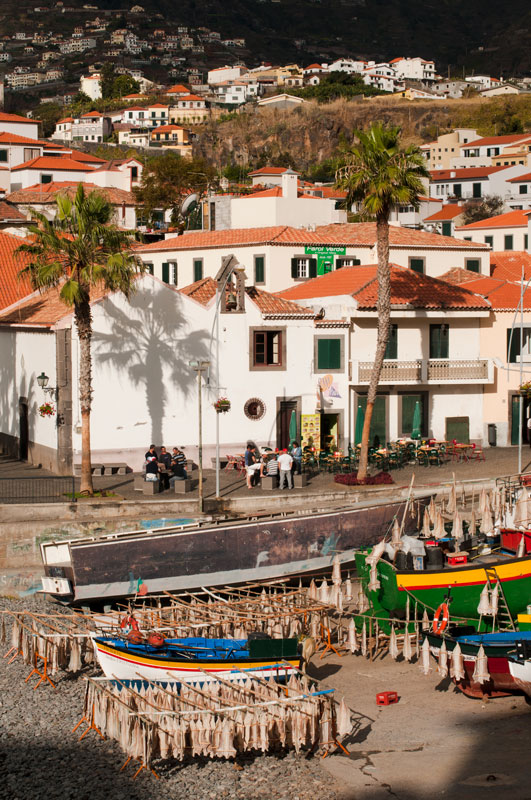
From the balcony we could see colorful fishermen's boats with drying bacalao salt cod – so at least, we thought, these actors knew what the fish looked like.


 The name of the town literally means  chamber of the wolves and its history deserves a mention too. The legend has it that the Portuguese discoverer João Gonçalves Zarco (who is credited with the discovery of the Madeira Islands) chose the location of the modern town for the very first disembarkation. He assessed the perfect natural conditions: a cliff forming and amphitheater shape that would protect ships from Atlantic storms. So Câmara de Lobos could very well be the very place where a human set his foot on Madeira.

Upon arrival Zarco and his men also found a large colony of marine animals – sea lions or lobos-marinhos (sea wolves in Portuguese). Apparently sea lions were either looking very important or were communicating so loudly, that they reminded seamen of the members of câmaramunicipal chamber. So they baptized the city with this pejorative term: Câmara de Lobos - Municipal chamber of Sea-Lions.

I would like to illustrate this part of the story with some pictures of lobos. Alas, this species of monk seals now live only in a small colony on Ilhas Desertas – uninhabited islands that are a protected Nature Reserve and constitute a part of Madeira archipelago. This is right, contrary to the popular belief Madeira is not just an island but also a part of archipelago named after its biggest island.
So even though you cannot see monk seals in Câmara de Lobos anymore, fishermen, as we found out, are more than real.
It was midday so the morning part of their job was done: nets taken out, cleaned and hung to dry, fish delivered to the market – time for some social life. And there they were: sitting on the benches on cute little plazas, they were playing dominoes, commenting the game so loudly and emotionally that we had no doubt: these fishermen were real. The hired actors would have been fired for scaring tourists away with their loud exclamations. Good thing we could not understand what exactly they were screaming at each other!


Walk along the boardwalk to snap the views of the city with agricultural terraces in the background.


Make sure you take the stairs to the upper level of boardwalk leading farther along the coast. You will be rewarded with view of Cabo Girao, one of the highest cliffs in Europe with the village of Ribeira Brava bravely climbing up its slopes.


After walking up and down the narrow streets the idea of having a fresh seafood lunch seemed more and more appealing. To our disappointment, we could not find anything. There were a couple of bars where fishermen were gulping vital energy. There were a couple of sandwich places. There was a rather modern looking restaurant that had a couple of seafood dishes advertised on the menu – not the abundance we were hoping for, and anyway it was closed. There even was a churrascaria – Brazilian Steakhose – not something we were hoping to find at fishing village…


Losing hopes and growing appetite we headed back to Churchill's pub, but it was closed, too. According to local custom, there was no sign with opening times so it could be in a couple of minutes, couple of hours or even months – till the season starts. We had no way of knowing.
As the hunger was growing we decided to return to Funchal for lunch.
From the Churchill's balcony we gave the last look to the colorful boats, white houses and drying fish of Câmara de Lobos.


Located so close to Funchal and glamorous hotels of Lido, it has somehow kept its rough charm and was not turned into another manicured resort for rich and famous. But maybe this proximity was something that actually helped this village freeze in time.  Tourist buses only stop here for half hour, crowds of tourists snap colorful shots and disappear towards other attractions. Those with money opt for the glam of comfortable modern resorts… And fishermen of Câmara de Lobos keep drying bacalao on their colorful boats, playing dominoes, shouting and drinking poncha…

Tuesday, February 7, 2012

Landscapes of Madeira

Here are some Madeira landscapes
View of Funchal from Monte
One of the most stunning views on the island opens up from Eira do Serrado and is included in most island tours along with cable car and toboggan ride.


Viewpoint and the nearby restaurant overlook the village called Curral das Freiras - Valley of Nuns. The name derives from the fact that threatened by pirate attacks the nuns relocated here as this is the only village on the island that does not have a sew view. The reason they had so many nuns is that colonial governors and ministers relocated here with their families. As they were all representatives of noble families there were not enough husbands of the same rank. Since they did not have a suitable mate and therefore  could not start married life the daughters of the noble families had no other option but to became nuns.


Sad stories aside, now it is a beautiful village that specializes in production of cherry and chestnut. Make sure you try one of the chestnut cakes!