Showing posts with label food. Show all posts

Sunday, September 30, 2012

Georgian food or do not touch khinkali with fork and knife.

And finally came the moment to talk about such important aspect of our trip as Georgian food.
Of course, we had heard a lot about Georgian cuisine and even tasted it in Tallinn and during our trip to Saint -Petersburg, so our expectations were high.
First we tasted Georgian food in Georgia proper coming back from David-Gareji and Sighnaghi on the very first day. Then when we traveled with Vadim sumptuous meal was an integral part of our journey - be it on roadside next to Mtskheta after we visited Shio-Mgvime monastery, fresh trout from the farm after the visit to Vardzia or hilltop restaurant overlooking Ilia lake after the visit to Kvareli wine factory.
There was big difference though: touring with Vadim not only do you get to see monuments, but you are also exposed to the tradition of supra - Georgian plentiful feast.

Supra is characterized by a wide assortment of dishes, large amounts of wine, long duration (supra can last for hours) and the special toastmaster - tamada guiding the feast. Tamada's responsibility is to introduce each toast and the rest develop the idea with each of the guests trying to be more eloquent, sharp-minded, original. Therefore a good tamada must feel the table and be himself very eloquent, intelligent, sharp and quick-thinking. The toasts follow each other in a certain order, starting form "Let us drink to God giving us this world" and drinking separately to parents, children, siblings, grandparents, more distant relatives who created this country and built beautiful monuments, to the homeland, to peace... It is considered low class for tamada to start proposing toasts to each guest at the table - meaning tamada is out of inspiration. However, on some occasions one of the guests is honored by being toasted for. In this case he must say a sort of 'return toast' before he is allowed to drink his wine.
Toasting to someone at the table for Georgians is a way to express something that people do not always feel at ease to talk about: thank a friend for his help and support, mention someone's generosity, honesty... This also has another powerful effect: being complimented on his own, let's say, generosity or honesty in front of all the friends, the person will feel he needs to keep up with the praise and show his best qualities.
In case of the guests' visit, the head of the house will usually assume the role of tamada. As we were guests in Vadim's big home - Georgia - he was our unchallenged tamada.

Dinner at Ilia lake next to Kvareli with Vadim presiding the table.
Unlike in most countries where each one orders his own appetizers, salads and main dishes, at Georgian table all dishes are brought on sort of 'community plates' and placed in the middle of the table. Each participant will then take food from the community plates and pass it over to his personal plate. I guess, in Georgia you cannot find people allergic to certain products, vegetarians, those following gluten-free diet and so on. Everybody eats everything brought to the table. And since Georgians are known to live hundred years being in excellent shape (and drinking a couple of glasses of wine every day), their diet seems to be working.
So let us look at the supra table.
First, the bread is brought. Traditional Georgian breads are baked in a large well-shaped oven called T'one so the bread itself is called Tonis Puri.

Tonis Puri on sale at Telavi market
And this is how it is served (well, bread baskets are common in other cultures as well).


Then come appetizers. Again, they are not served individually but placed in the middle for everyone to sample. One popular appetizer is nigvziani badrijani (ნიგვზიანი ბადრიჯანი) made with fried eggplant covered with spiced walnut paste.


Another variation on what can be done with eggplants - badrijani with garlic: they are fried and served with pound garlic paste.


Every Georgian meal is also accompanied by cheese. As you could remember from our trip to Telavi market it is a white, slight sour and a little salty cheese - elastic and dimpled. Suluguni is produced only of natural ingredients and is a "quick cheese" maturing in just one or two days: Georgians do not seem to favor hard matured yellow cheeses. 
A folk etymology posits that the name sulguni comes from two Georgian words - suli (which means "soul") and guli (which means "heart").

Suluguni - Georgian heart and soul on sale at Telavi market.
Another kind of cheese is not even shaped into flat disks: it is loose and mixed with fresh mint - very unusual and goes very well with white wine.


Basturma - air-dried cured beef - is another popular appetizer. This dish exists in many countries of Caucasus, as well as in Turkey and on Balkan peninsula. It is usually served as a mezze in thin slices. Georgian variety is very tender, does not have slices of fat and is seasoned with paprika.


Unlike in some other countries with hot climate, Georgian cuisine is not hot so no worries, your mouth will not burn. They do use and sell a lot of herbs, but it is definitely not a priority to disguise the taste under burning hot spices.

Red paprika on sale at Telavi market.

From our visit to Kvareli wine factory we learned why Georgian wine is so special and different from any other wine-making country in the world. We were also explained the traditions of Georgian wine-drinking. We were surprised to find out that most Georgians drink white wine at supras. They explain that white wine does not make you drunk too quickly and allows you to spend more time at the table. While red is treated as a sort of medicine as it is richer in antioxidants and is drunk at lunch - just a couple glasses. Even monks at Vardzia or Gelati had to drink several glasses a day: they crashed bread into bowls and ate it as a sourse of vitamins. The monks spend a lot of time fasting and need to replenish vitamins and elements that they cannot get from their modest food. Georgians are certain that drinking a couple of glasses of red wine a day serves as preventive measures against heart diseases, headaches, promotes vein elasticity - in short, it is an elixir of not of youth, but of healthy and long mature age.
Georgians in the countryside mostly do not bother with the bottles - how many of them needed for one decent supra?! - and prefer buying their amber-colored whites in such big plastic plastic bottles, The wine is served from the pitchers.

Vadim and wine - before being poured into the pitcher
Another unusual detail is that they do not seem to favor salads - in the sense of group of products with a certain dressing. Georgian salad contains no dressing but fresh tomatoes and cucumbers, chopped, sprinkled with a tiny bit of salt, shredded onion, basil and coriander.
As to mayonnaise-based salads - we did not meet them at all.


An indispensable part of Georgian table - not only at dinner but even at breakfast is khachapuri (ხაჭაპური or "cheese bread") - a filled bread dish. The bread is leavened and allowed to rise, and is shaped in various ways. The filling contains cheese (fresh or aged, most commonly suluguni), eggs and other ingredients. Of course, each region of Georgia has its own variety of khachapuri with Imeretian (also called Imeruli - pictured below) being circular and probably the most common type. While Mingrelian variety (Megruli) is very similar but has more cheese on top. Abkhazian version - achma - has multiple layers and can be compared to a lasagna with cheese but without sauce or a salty mile-feuille.  Adjarian khachapuri (also called adjaruli) is, probably, the most unusual variation: the dough is formed into an open boat shape and the hot pie is topped with a raw egg and a pat of butter before serving
As a Georgian staple food, the price of making a Khachapuri is used as a measure of inflation in different Georgian cities by the Khachapuri index.


Imeruli
After khachapuri comes heavy artillery - meat dishes with shashlik (also called mtsvadi) being one of definite favorites. Sometimes meat for shashlik is not marinated, but mostly it stays overnight in a high-acidity marinade like vinegar, dry wine or sour fruit/vegetable juice with the addition of herbs and spices. Again it is served on community plate sprinkled with shredded purple onion.


Shashlik is usually cooked on a grill called a mangal. During social gatherings shashlyk cooked outdoors is one of the most popular modes of consumption.

Shashlik expert at work behind his mangal
The last hit on stomach comes with khinkali (ხინკალი). By the time they arrived we were too full and lazy to reach for the camera so we have no photos (next time!) but we will still try to describe it and teach you how it is eaten. Khinkali is essentially a big dumpling (or Georgian dim-sum) filled mostly with spiced meat (usually beef and pork, sometimes mutton), greens, and onions.
It is eaten plain, or with coarse black pepper. The meat filling is uncooked when the Khinkali is assembled, so when cooked the juices of the meat are trapped inside the dumpling and this juicy broth is considered its best part.
Dare not taking a khinkali from the community plate using a fork! The entire table or even the entire restaurant will exclaim in disapproval of your vandalism. It is is to be taken from the plate using your hand only. It can be eaten with hands as well but if you want to show you manners you can use the fork to pierce the top where the pleats meet: it is tough and not supposed to be eaten anyway. The tops (Georgians tenderly call them "kuchi" (კუჭი) 'belly button') then stay on the plate and indicate how many pieces were consumed.
After you pierce the 'belly-button' with your fork take the first bite and suck out the juice. Work you way through the khinkali sucking the broth with every bite, do not lose a drop of it!
It takes practice but under proper guidance from locals you will soon be able to eat like a pro.

One aspect of a Georgian table that we never encountered is dessert. Good we did not for after every meal we were full & happy anyway. The only treat for a sweet tooth we tried was churchkhela (ჩურჩხელა) - traditional sausage-shaped candies.
The main ingredients are grape must, nuts and flour. Almonds, walnuts, hazel nuts and sometimes raisins are threaded onto a string, dipped in thickened grape juice and dried in the shape of a sausage.

Churchkhela on sale at Telavi market
Grape must is placed in a large bronze cauldron (called chartzin or kazani) and heated slowly.Then white earth and white floor are added. When the mix gets the right amount of bubbles it is considered to reach the desired consistency and removed from the heat. Next the strings of nuts are made, dipped in the mixture until completely covered and left to dry. The process is repeated several times (usually three times) until churchkhela reaches the desired thickness. 
After 5-6 days of drying they are ready to eat. They say, it can be kept without any preservatives till New Year, but it is hard to be verified in practice: kids in every family make sure the churchkhelas are eaten before the winter comes.

Georgian table is abundant and plentiful, but - surprisingly enough - when you leave the table you feel nicely full, not disgustingly full. Having communal plates allows you to taste a bit of every dish without eating the entire portion. So you have a bit of bread, cheese, veggies, meat (and quite a bit of wine) and can still breath, talk and move.
We were worried our stomachs would react to unusual cuisine and brought a bunch of medicine, but we did not need any. Georgian cooks have perfected these dishes for centuries so now they are absolutely 'foreigner safe'. And (even though they look like nothing like the foods marked '100% natural' or '100% organic' in your supermarkets), they are natural, organic and healthy. Georgians are known to live over hundred years old and their cuisine and wine could be a clue to their secret.

<<<<Previous post                Next post>>>>

Friday, June 29, 2012

Food and travel

The food is a very big part of our travel experience. But even though we already started with some pointers for restaurants worth of try and food curiosities out there, we think that there are still many aspects that travelers often do not take in consideration while abroad.

Here are some thoughts how to better enjoy food while traveling.

1. First and foremost, in order to enjoy all these strange or even weird food stuff out there you have to stop comparing it to what you are used to back home.
Have you ever tried limpets?
How about Banana-Ananaz?


Maracua-Ananaz?

Maracuja-Tomato or Banana-Maracuja?
...or.. this fruit? (Sorry we did not get its name)
2. Second – keep an open mind, quite often things or combination of things what you never considered edible can be rather delicious.
How about Scabbard fish with shrimp mousse and... banana?


3. The third rule what we have on our travels is to eat and drink the local!!

Famous Spanish ham - Jamón serrano
Jamón serrano (Spain)
Basque pintxos (small snacks served on a slice of white bread and spiked with a skewer or toothpick)
Grilled Octopus (Greece)
However it is not always possible but at least we try it and make adjustments afterwards: there are places in the world where there is no authentic local food available or it is not really considered edible by our standards. Caribbean islands being a good example: the only authentic food there we found – conch fritters - and it basically tastes like deep fried anything. And as locals deep fry everything, even deliciously fresh local fish is killed properly in boiling oil. But man has to eat so we had to stick to some touristy fusion restaurants where, despite the price factor, it is possible to find something more palatable.
And speaking of Caribbean – while on beach try to avoid the so cool beach Rasta bar! They more often then not make these exotic cocktails in umbrella infested coconut shells with some cheap local industrial Rum. It looks good, but it makes you 
very drunk very fast and as a free addition you will kill much more brain cells then you calculated for + terrible headache will follow the exotic experience and spoil the rest of your day. We know – we tried , and shameful to say but more then twice.


But back to food….

4. It is also important to understand that in different regions people have different eating habits time-wise – for example southern people in Europe eat their dinner much later then northerners are used to. Adjusting your biological clock to new rhythm is often the hardest part. So if you try eating at the time you are used to while on vacation you might be limited to food establishments that are open only for tourists and will miss all the authentic experience. Try to find food before 7:30pm in the Mediterranean! The only option you will have is sandwich, burger or kebab. All restaurants where locals eat will not open their doors before 7:30pm and the kitchen will follow at 8:00pm. It is logical: all boutiques and shops (except for a handful of big supermarkets) are open till 7. So the employees have time to close the business and make it to dinner.

Do not believe the signage telling you about authentic food experience in tourist restaurants – we have visited more than 70 different countries and tourist traps sell always some fusion of local stuff and the chef's idea of what a tourist is supposed to like ( usually burger with some local addition ).


5. As a rule of thumb – places where locals gather and what tend to be crowded at peak hours - though often funny hole in the wall that does not smell so nice – tend to have the best food. Beautiful sea view and overpriced burger are usually reserved for misinformed tourists with heavy wallets.

As comes to Spanish cuisine (last 4 months we have been cruising between Spain main land and Canary Islands) we ended up pleasantly surprised by the variety and quality of food.


Of course, we have to stop longer on tapas tradition. We absolutely love this format of food. You wish just a snack with your wine take one tapas, you feel bit hungrier – let us have another one.

An example of tapas platter served in Teguise, Lanzarote, Canaries Islands
They are comfortably small portions with endless variety of food combinations priced from 1 euro in rural areas up to 3-4 euros in Barcelona fancyish wine bars. Usually finger licking delicious and affordable snack, and when you get to know tapas geography better then there is kind’ a sport of Tapas hopping – bit of wine and white bait in that bar, glass of vermouth and blood sausage in other… and so on as much your head and wallet can take.

Pan con tomate - bread with tomato - a typical Catalan starter, in some places is still served automatically
Pimientos de Padrón - a variety of sweet peppers coming from  Padrón fried in olive oil 
Canarian tapas platter: chorizo (sausage), olives, fried bread, pimientos  de Padrón, variety of cheeses and gofio - typical Canaraian food.
And there come Spanish classics like Jamon Iberico (Local dried ham, depends on region taste varies – our favorite being slightly smoked)...

...all kinds of Morcilla (black pudding that usually comes in the shape of sausage, but can be just dish made with blood – no –no food for vegetarians )...

...seafood in coastal towns ( you cant get shrimp taste so sweet if it is still not dancing while you cook it)...

In fish market in Cadiz we got serious drooling fit – the selection was huge, crustaceans alone were 6 different kinds + lots of fish - some still alive. Olives are supposedly the best in Cadiz region, but French from Provence boast the same about their olives and Italians - about their Sicilian olives.  So at the end of the day you have to visit all these places and choose your favorite – seriously hard task, they are all so good. But we are up to the challenge.


And each village (or actually each finca) makes them their own special way, how they were taught by their parents and grandparents – a world of tastes in this little olive.


Soon to be continued.....


P.S. Read more about pasta in La Laguna & simple food in the Canaries.

Wednesday, June 27, 2012

Word in defense of pasta

We must admit we never thought high about pasta.

Most probably it has to do with the way we were brought up. In Italy pasta is worshipped and considered a form of art. Names are lovingly and thoughtfully given to different shapes – fettuccine, cannelloni, orzo, penne, linguini, pappardelle… Same comes to sauces – carbonara, marinara, Bolognese…Cooking pasta to achieve the desired texture – not too hard yet not overboiled soft – is considered skill that requires a lot of practice and not everyone can master.


Unlike in Italy, back home all shapes are named macaronis with the only exception of spaghetti. Macaronis, along with boiled sausage and hard-boiled egg, are considered bachelor’s food. So here we have it: no need to peel, chop, pre-heat pan to a certain temperature. Just make the water boil, drop half-pack in and single man’s dinner is ready. Advanced bachelors can add canned meat thus achieving and advanced form – макароны по-флотски or seamen’s pasta.


That is pretty much it with pasta back home.

So with that in mind the perspective of going to a restaurant and ordering something that back home can be cooked even by a culinary-challenged man, did not appeal to us.


Unappealing it was until, while hiding from unexpectedly started rain, we walked in the hospitable open doors of Rucola & Grana, Italian restaurant in La Laguna on Tenerife island.


We were full so we were not looking for anything but a cup of hot double espresso. But when a waiter gracefully placed a plate of pasta on a neighbor’s table we felt that our pre-conception about pasta started to shake.

Not only were we full but also in a hurry but we did feel that Rucola & Grana was a good reason to pay another visit to La Laguna. And what can be a better way to spend our last call to Tenerife?


For starters we ordered focaccia with extra garlic to share.


For the main course we chose two different kinds of pasta – the very reason we came all the way here. The menu was only in Spanish so till the last moment it was a mystery what we would get. We ordered Cappelletti rellenos de carne, con salsa de tomate, jamón serrano, rucola y queso ahumado - as much as we know Spanish the idea of queso ahumado (smoked cheese) seemed appealng. The other pasta was Trío de rosette de pasta rellena de: ricotta y espinacas, jamón y fontina, setas y ricotta, gratinado al horno con bechamel, parmesano y salsa de tomate - we figured that since it is trio there would be three different kinds of pasta and if we don't like one of them we wont leave hungry.
Unfortunately their official site is only in Spanish but if you happen to be in La Laguna, here you can find more info in English.


Trío de rosette de pasta rellena de: ricotta y espinacas, jamón y fontina, setas y ricotta, gratinado al horno con bechamel, parmesano y salsa de tomate

Cappelletti rellenos de carne, con salsa de tomate, jamón serrano, rucola y queso ahumado
This was honestly the best pasta we ever tried. Funnily enough, it was not in Italy (as the best pizza what we had was not in Napoli!) but this tiny restaurant on an island in the middle of the Atlantic made our day. If you want to restore your faith in pasta pay a visit to Rucola Y Grana.


Wednesday, April 25, 2012

Ode to simple food

What has happened, presumably in the interest of more consistent nourishment, is that individual tastes and local flavours have taken a terrible beating at the hands of mass-producers. A Third Avenue hamburger tastes exactly like Champs Elysées hamburger.  Chicken, once a bird, has been turned into a commodity along with pork,beef and lamb. And as for vegetables — when was the last time you ate a tomato, a potato or a salad that you didn't have to smother with sauce or dressing before there was any hint of flavour?
Bread like plastic, apples like wet socks, cheese with delicate complexity of a bar of cheap soap, onions with no bite, spinach that would make Popeye choke. It all looks genuine because everything from the lamb chop to the string bean is bred for appearance, but its resemblance to real food stops the moment you start to chew.
Peter Mayle. Expensive habits.


I took liberty of starting with such a long quotation because I couldn't have said it better. And mind it, this was written 20 years ago and the things did not exactly improve since.
After having spent so many contracts in States we were longing to stay for 6 month in Europe not only because of its undoubted cultural, historical and architectural treasures but also because our mouths we already watering in anticipation of fresh, unique and creative European food.


And even though we have visited quite a few places that made even traditional Russian Olivier Salad — here called ensladilla russa — look like a sophisticated dish... 


...we never lost the edge for trying simple "hole in the wall" places and simple foods. And so far — we are surprised ourselves! — – we liked pretty much everything we tasted.


In States people appreciate predictability in food: most restaurants are a part of huge franchises. So be it a burger place, seafood restaurant, Italian trattoria or Mexican cantina, one can be sure to find exactly same menu from Washington to Florida, from Maine to California. You know exactly what you are paying for and your dish will look, taste and cost exactly same, be it Alaska or Hawaii.

Europeans, on the other hand, take pride in being different. There is always a “secret ingredient” – different kind of salt, an herb, a spice, maybe sauce, method of cooking or presentation that will make difference between two same dishes served in that specific restaurant or the one next door, let alone on the other side of the country.

But there are very simple foods with only one secret ingredient: freshness.


Trundling around Teguise we were not anymore hungry after a good lunch, but wanted to extend the pleasure of being in this cute little sun-bleached town. So we landed for a snack at La Cantina.

We ordered simplest dishes: white bait and pimientos padrón – small green peppers (originally from municipality of Padrón) fried in olive oil. The food came on wooden planks and was accompanied by freshly baked bread and coarse salt.  


Another simple dish we discovered in Canaries is papas arrugadas — wrinked potatoes. Being from Belarus and Estonia we thought we knew all possible ways of cooking potatoes but the Canareños proved us wrong.  They are small potatoes (they say the yellow-fleshed Tenerife variety are best) boiled in their skins in salty water. They are then dried over a low heat untill the skins become wrinkly and is covered by salty crust. It can be a side dish served with meat or fish or simply as tapas . The dish is said to have been invented by fishermen who boiled potatoes in seawater.
Despite its seeming simplicity it is a delight to your senses and we are excited to try it when at home: we will be there in time of "young potatoes".


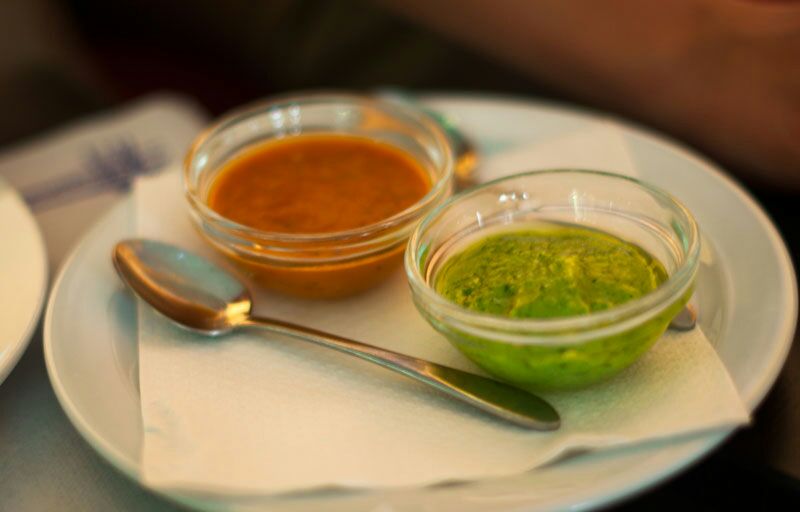
Traditionally it is served with two sauces: mojo rojo, whose basic ingredients are tomatoes, peppers and paprika (mojo picón is its spicy version and contains hot chili as well) and mojo verde — a green sauce made with oil, vinegar, garlic, coriander and parsley.  The sauces come in small bowls so you can use as much or as little as you like.


But we found another perfect addition: garlic shrimp served in sizzling oil with crunchy garlic chips.


And coming back to where we started, if you have a chance — look for one of Peter Mayle books. He is British who got fed up with fish and chips, fog and rain and moved to Provence. He lives a busy life sharing his time between wine tastings, frog tastings, escargot tastings, pastis tastings and whatever else the French are prod of. He then describes his impressions in his books and even though he covers more or less the same topic — life in Provence with all its tastes and flavours — he manages to keep us interested with his witty style, ironic observations and eagerness to learn, smell and taste more. 


More about  food and travel - here!
Published with Blogger-droid v2.0.4

Saturday, March 3, 2012

San Cristobal de La Laguna

First impression on Tenerife was a bit disappointing. Rather high and rather modern buildings and even a tower reminding of Stalin’s buildings in Moscow – that did not make a nice first impression. Later on wondering on the streets of Santa Cruz we were able to find a beautiful church and a couple of colorful facades but most landmarks (such as Plaza de España and Auditorio de Tenerife) looked rather modern.
The mystery was solved when one of the guests told us about his trip to the island’s former capital, UNESCO Heritage site – San Cristobal de La Laguna or simply La Laguna.
As the name might prompt it derives from the lake – Saint Christopher on the Lake. Nowadays the lake is long gone but the name survived.
It easy very easy to get to La Laguna: simply take a tram in the direction of Trinidad and go till the last stop. Round trip costs 2.50€, the tickets are sold right on the tram stops from a ticketing machine. Since there is no English make sure you choose ida y vuelta option for return tickets and of course validate them once on the tram.
Tenerife tram (Tranvía de Tenerife) was first opened in 1907 and was in operation until 1951, when, due to a series of problems and accidents, and increased competition with the car and bus (on Tenerife, buses are called guaguas), the service was discontinued. The tram was reopened in 2007. It is the only existing tramway or train in the Canary Islands.
The ride took us about 35 minutes. But when the mechanical female voice announced La Termina – the final station – we were in the middle of uninteresting buildings from circa 70’s. We even started thinking we had taken the wrong tram or the wrong direction. Do not get discouraged! Walk just a little bit forward and at the next crossroads the old city will start opening up in front of you.


To help you find main attractions the city has scattered boards with city plans all over the old city. All cathedrals and convents are marked on it.

Start your day with a coffee at El Jardin del Hada (Fairy’s Garden) on Calle Capitan Brotons, n2: they are open from 8am (except Sunday). They have a nice breakfast menu with crepes, fresh juices, sandwiches, salads and montaditos (another way to call tapas) for 1 euro each. But the reason we liked this place is its fairytale atmosphere with stylish wall paintings and cute little tables.

La Laguna was founded  between 1496 and 1497 by Alonso Fernández de Lugo and was the capital of the island after the conclusion of the conquest of the islands. As the capital it quickly attracted attention of adventures of all sorts and became a boom town.

Despite the fact that most buildings in the old part of city date back to Renaissance period La Laguna give somehow a modern feel. This is due to the fact that unlike most ancient cities La Laguna was planed: the houses are not crammed on top of each other but are stately aligned along the wide streets.


Renaissance was the time of pursuit of perfection: ideal man, ideal city. Not only architects but also artists and philosophers were creating their own projects of ideal city: circular, octagon, star shaped... Most of these projects remained on paper but since the La Laguna was build from scratch, its founders were able to apply the progressive ideas of the time. La Laguna is the first city in the world built on geometric grid. And since it was a departure point for many expeditions to the New World now wonder colonists applied it as a model to virtually every city in South and Central America.


Some even say that not only the city plan but even the accent was brought to the new world so some mainland Spaniards (or Peninsulares - folks from peninsula) take Isleños (the islanders) for Latin Americans.
However the city population and economy declined so in the 18th century (1723 to be exact) the capital was transferred to nearby Santa Cruz where it remained ever since. Both cities have since grown so nowadays they form one municipality and one cannot tell where the Santa Cruz ends and La Laguna starts. As opposed to modern looking capital La Laguna remains cultural and education center (University of La Laguna is an education center famous all over Spain with over 30,000 students), more slow-paced with many streets closed for traffic.

Streets of La Laguna with Dragon Tree
Dragon tree is not a tree but a relative of asparagus (belongs to family Asparagaceae)
Paradoxically, the fact that the capital was moved to Santa Cruz helped La Laguna to retain its historical core.


Had it remained in La Laguna we could have seen more modern buildings, cars, parkings...

Luckily now one can quietly stroll on the streets enjoying traditional colonial architecture: convents...


...churches...


...stone carving...


...wooden balconies...


Some monuments were never restored (apparently it was not that important since it was no longer the capital) but even in ruins they sure have their charm:


The most important religious building of La Laguna has traditionally long name: The Cathedral of San Cristóbal de La Laguna or Catedral de Nuestra Señora de los Remedios (Santa Iglesia Catedral de San Cristóbal de La Laguna in Spanish).


Unfortunately at the time of our visit it was closed for restoration so we were not able to see it from the inside and on the pictures there were always cranes and scaffolding:


Apparently the restoration includes some major work done:
The cathedral was constructed from concrete, one of the first buildings in Spain to use a material which is now used extensively in a wide range of buildings. Unfortunately, having been a pioneer in this field, the technology was not fully developed; as a result it developed numerous faults which required large amounts of repair and improvement work.  ©Wikipedia
So at the moment (and apparently for a long while) it is only possible to see the exterior.


A church that gives you more options is The Iglesia-Parroquia Matriz de Nuestra Señora de La Concepción (Church of the Immaculate Conception), almost a twin of the Church of the Conception of Santa Cruz de Tenerife.


Not only will you be able to visit its interior (for a fee) you can also climb the tower to view much of the city.  The visit to the tower only costs 1€ (the ticket to the church includes the bell tower) and the view are truly incredible:


It is easy to spend a day here as around every corner you might see another beautiful building...


Convent with characteristic wooden balconies
...an architectural detail...


...or an unusual plant.


Watch street performers at work...


...or hide from heat behind the thick walls of one of the cafes


Running around the city made us hungry so we started paying attention not only at cathedrals but also at the menus of nearby restaurants. Soon we spotted an unusual menu: it was big and colorful and featured 20 different pintxos. Near each photo there was a description in Spanish - but who cares? We will be able to see the photo of what we order!

But while description of some tapas made our mouths water right away - Carpaccio de Pulpo (Octopus Carpaccio), Brocheta de Langostinos y Bacon (Brochette with shrimp and bacon) - others made us scratch our heads. How about Croqueta de Morcilla consisting of Morcilla dulce and Pistacho - morcilla for all we knew was a black pudding but can it be sweet (dulce) and accompanied by pistachios?
Some were even more mysterious as we could not decipher even one ingredient: what could be Bogavante made of Codos de Bogavante and Crema de Cava? Yet everything looked so inviting that we enthusiastically embarked on this voyage to the unknown pointing at various tapas. Luckily you don't need to settle for one favorite as each pintxo costs between 2 and 3€ so you can easily select several, share and then... order more! Everything we ordered (and we returned to this restaurant on one of the following visits and tried more!) was an absolute delight.  Each dish was presented differently: there was crepe, tartalette, brochette... Some were served on lava rock, some in a glass, some on a slice of bread, some on the stick and some  - on asparagus. Various ingredients were used: there was smoked salmon, iberico ham, shrimp, octopus, black pudding, goat cheese, foie, anchovies, mushrooms - all with creative reductions and sauces.

The  restaurant is called Sorgin Gorri and despite its unpretentious looks it definitely takes ancient Spanish tradition of tapas to a whole new level.
Sorgin Gorri interior with menus on each table
We definitely recommend to stop there for a couple of pitxos. But keep in mind, most probably it will be more than just a couple!


Read about another great culinary experience in La Laguna here.