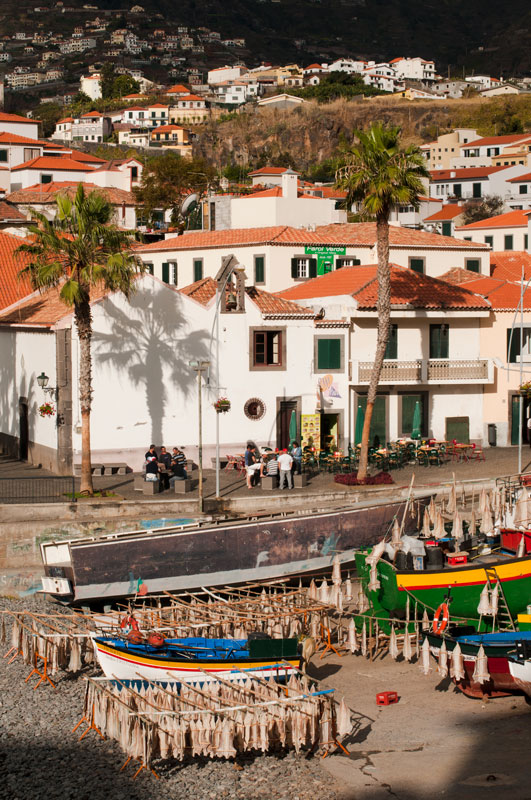
This small town has always intrigued us: located near Funchal, it was promised to be a typical fishermen's village that became popular thanks to Sir Winston Churchill.
As to typical fishermen's village, we were not exactly buying it as so many times "typical villages" – be it fishermen's, Bedouin, Indian – ended up looking more like a movie set with hired actors. The jeeps were parked behind "Bedouin huts", "kids playing in the mud" had brand clothes hidden under the bush and "tribal chief" was secretly peeking at his mobile phone. In other words we were skeptical about the authenticity of fishermen.
The Churchill legend however seemed way more probable: British presence on Madeira has been strong for the last couple hundred years. It started in the times when half of the world was shaded green (for some reason this was the color most cartographists picked for Great Britain). After having served their tour of duty in the Caribbean, India or Africa British functionaries from colonial administration were happy to return home. But happy they were only until the arrival of winter as they were not anymore resistant to cold. As the first cold winds started blowing they were on a search for a new home: in a warm place yet civilized and not too far from Britain.
Madeira with its mild climate (+150C wintertime and +250C summertime) was ideal.
British founded Monte – summer refuge in the mountains 800m above the sea level, took export of Madeira wine to a whole new level making it popular worldwide, so why not to believe that Sir Winston gave good exposure to this village?
First, as according to the map it was only a few kilometers away from Funchal (walking distance for us!) we decided to walk there. Not a good idea (well, unless you are not on a cruise ship and have more than a couple of hours and muscular legs). On the positive side, at least we learnt that "a couple kilometers" in Madeira is different from "a couple kilometers" elsewhere. Mountainous terrain makes distances shown on the map longer with winding roads, ups and downs, blind bends… Plus, if you are traveling by public bus you need to foresee time for the driver to exchange local news at every stop.
But that's a story for another day.
Eventually we walked till Lido – more modern part with spiffy hotels – gave up and took a cab. We were happy we did: 15€ each way seemed a fair price to pay for the ride that took us good 15 minutes (yep, that's "a couple kilometers" in Madeira!). Alternatively one of hop-on / hop-off buses (blue color) can take you there but if Câmara de Lobos is your only destination then taxi will be quicker, more efficient and not that much more expensive (hop on buses are 12€), especially, if there are more than 2 in your group. Of course, interurban buses can also take you there but we could not quite figure the way to read their timetables. However you are welcome to check out Madeira public transport site and let us know how it goes.
The driver suggested to pick us up but when told we did not know how much time we were going to spend there he got surprised that someone might wish to spend there more than an hour. This was not too encouraging but we decided to stick to the plan.
The taxi dropped us off near Churchill Pub that was at that time closed but we were optimistic it was going to open later in the afternoon. Next to it was Churchill's balcony – the vantage point that Sir Winston chose for his watercolor landscapes.
And I am sure you would agree – the man had a good eye for viewpoints:
From the balcony we could see colorful fishermen's boats with drying bacalao – salt cod – so at least, we thought, these actors knew what the fish looked like.
The name of the town literally means chamber of the wolves and its history deserves a mention too. The legend has it that the Portuguese discoverer João Gonçalves Zarco (who is credited with the discovery of the Madeira Islands) chose the location of the modern town for the very first disembarkation. He assessed the perfect natural conditions: a cliff forming and amphitheater shape that would protect ships from Atlantic storms. So Câmara de Lobos could very well be the very place where a human set his foot on Madeira.
Upon arrival Zarco and his men also found a large colony of marine animals – sea lions or lobos-marinhos (sea wolves in Portuguese). Apparently sea lions were either looking very important or were communicating so loudly, that they reminded seamen of the members of câmara – municipal chamber. So they baptized the city with this pejorative term: Câmara de Lobos - Municipal chamber of Sea-Lions.
I would like to illustrate this part of the story with some pictures of lobos. Alas, this species of monk seals now live only in a small colony on Ilhas Desertas – uninhabited islands that are a protected Nature Reserve and constitute a part of Madeira archipelago. This is right, contrary to the popular belief Madeira is not just an island but also a part of archipelago named after its biggest island.
So even though you cannot see monk seals in Câmara de Lobos anymore, fishermen, as we found out, are more than real.
It was midday so the morning part of their job was done: nets taken out, cleaned and hung to dry, fish delivered to the market – time for some social life. And there they were: sitting on the benches on cute little plazas, they were playing dominoes, commenting the game so loudly and emotionally that we had no doubt: these fishermen were real. The hired actors would have been fired for scaring tourists away with their loud exclamations. Good thing we could not understand what exactly they were screaming at each other!
Walk along the boardwalk to snap the views of the city with agricultural terraces in the background.
Make sure you take the stairs to the upper level of boardwalk leading farther along the coast. You will be rewarded with view of Cabo Girao, one of the highest cliffs in Europe with the village of Ribeira Brava bravely climbing up its slopes.
After walking up and down the narrow streets the idea of having a fresh seafood lunch seemed more and more appealing. To our disappointment, we could not find anything. There were a couple of bars where fishermen were gulping vital energy. There were a couple of sandwich places. There was a rather modern looking restaurant that had a couple of seafood dishes advertised on the menu – not the abundance we were hoping for, and anyway it was closed. There even was a churrascaria – Brazilian Steakhose – not something we were hoping to find at fishing village…
Losing hopes and growing appetite we headed back to Churchill's pub, but it was closed, too. According to local custom, there was no sign with opening times so it could be in a couple of minutes, couple of hours or even months – till the season starts. We had no way of knowing.
As the hunger was growing we decided to return to Funchal for lunch.
From the Churchill's balcony we gave the last look to the colorful boats, white houses and drying fish of Câmara de Lobos.
Located so close to Funchal and glamorous hotels of Lido, it has somehow kept its rough charm and was not turned into another manicured resort for rich and famous. But maybe this proximity was something that actually helped this village freeze in time. Tourist buses only stop here for half hour, crowds of tourists snap colorful shots and disappear towards other attractions. Those with money opt for the glam of comfortable modern resorts… And fishermen of Câmara de Lobos keep drying bacalao on their colorful boats, playing dominoes, shouting and drinking poncha…