Saturday, June 9, 2012

Slovenia, Piran

The winter finished together with Canaries islands season. On repositioning cruise from Barcelona to Venice we stopped at Koper, Slovenia


We had never been to Slovenia before and since this was a "once off" repositioning cruise it was our only chance to see the country. Naturally, we did our "homework" and found out that even though the city of Koper had some historical buildings, the nearby city of Piran seemed a more attractive destination. Not only was the city full of historical attractions, not only was it poetically called an "open-air museum", it  was also located on a narrow peninsula surrounded by city walls. Unusual natural setting is an attraction on its own so decision was made in favor of Piran. We found out that Koper and Piran are connected by a bus line and during peak hours there is a bus every 15 minutes. The bus stop is about 3km away from the cruise ship terminal. There also is a bus stop closer to the city center but we could determine its location. If anyone knows it please drop a link.

However when we tried to get off the ship there was an unpleasant surprise: the ship had not yet been cleared for crew. Usually an hour after we dock is enough for custom clearance of both guests and crew as well as for all tours and most independent travelers to leave the ship. We were hoping the delay was short and went to the promenade deck to have a look at the city. We were perplexed to see on the pier a white tent with long queues. We were told that Slovenian authorities were checking passports of every single passenger. And there were only 2 customs officers. Mind it, it is 2,500 guests and over a thousand crew.
Dear Slovenian authorities! If you read these words, please, simplify the procedure! If the guests paid so much money to be on the cruise, plus hotels and airfare on the way there and back, they would not travel with fake documents. And the crew who have traveled the world, seen all the continents and crossed all the oceans are not interested to "jump the ship" on the only stop in Slovenia, without passport and belongings. I am not saying it does not happen. It does. But in different ports, under very different circumstances. But that is another story, for another day.

After having wasted so much time waiting we decided not to waste it anymore walking to the bus stop and waiting for the bus so we opted for a cab. So even though the ladies at the info stall were eager to show us the way to the bus we asked about the prices for the cab. The same ladies told us the prices started from 25€ one way.  We worded the price of  25€ right away and even though the driver chuckled and said it was too low he nevertheless agreed to it. So beware, after a  cruiser docks there will be many people and prices might grow up: we met other crewmembers in Piran and they paid 70 both ways.
Some taxi companies offer the option to pre-order the cab so you will be sure to have the cab and will have the price in advance.
The driver also offered to pick us up but as we had no phone and no definite plan we decided to try our luck in finding our own transportation back.

The drive through Slovenian countryside was gorgeous: well kept houses, neatly trimmed orchards and greenery. We could not believe that it used to be a part of one of the communist countries and that there was a war here only 10 years ago (ok, it only lasted 10 days but still) - not a trace of abandon or neglect.
Hilly winding roads made  13km (8.3 miles) last 40 minutes, even by cab. Plus, it was peak hour so our driver even had to take some shortcuts.

The taxi stopped right next to Tartini Square (Tartinijev trg in Slovenian or Piazza Tartini in Italian), the heart of Piran and one of the most photographed spots.

Tartini square
The square was named after the most notable son of the city, Giuseppe Tartini, violinist, composer and music theorist. His memory is treasured by Piranians: his monument adorns the square since the end of 19th century, his birthday is celebrated by a concert in the main town cathedral and one of the old stone warehouses on the square has been turned to a hotel bearing his name.

Guiseppe Tartini monument on the eponymous square

Guiseppe Tartini monument on the eponymous square
One might wonder how such a large square could survive in a medieval town, why it was not covered with a chaotic maze of medieval buildings, especially in the city located on a narrow peninsula where every square meter counts. Well, it was not always a square: up until the end of 19th century it was an inner dock for fishing boats, and was located outside of the first city walls. In the Middle Ages important buildings and palaces appeared around the dock thus making an important site of the town. The site however had a big disadvantage: the sewage from the city ended up in the harbor. No wonder in 1894 the officials decided to bury the dock and set up a square. The port that was littered and silted up was cleared of debris, filled, and redeveloped.
In recent years during the main season (July 1 to September 1) no vehicles are allowed to park within the square so it truly became the heart of the city: couples meet at the monument, families seat at the nearby cafés, young boys play football. After the game, just like grown up men, they talk about sport & cars.


Among the buildings that grew around the newly created platform one really stands out:  the gothic house named Benečanka, often simply called Venetian House. Built in the middle of the 15th century, it is the only building that has still preserved its original exterior.
This red palace is richly decorated with typical Venetian stone ornaments and architectural elements . The corner Gothic balcony is the most impressive.

Between the windows on the second floor there is an immured stone relief with a standing lion; under the lion you can read the inscription "Lassa pur dir".
According to Piran Board of Tourism site  there is a legend behind it. When Piran was a a part of Venetian Republic and was an important trade port, a rich Venetian merchant fell in love with a local girl. The envious citizens disapproved of their union. So in order to show his love, wealth and at the same time demonstrate his defiance of public opinion, he built a beautiful palace and decorated it with the inscription still preserved on the  façade: "Lassa pur dir" - “Let them talk”.

Benečanka, often simply called Venetian House
The famous Benečanka balcony

We decided to look around and dove into the labyrinth of cute little streets. Soon we found ourselves on the 1st of May Square or the Old Square (Piazza Vecchia), as it was first named. The Old Square used to be the administrative centre of the town until the 13th Century.
If you look at the city aerial view you will notice that the city is very densely built and this is the only square in Piran other than Tartini's. And again, there is a reason why nothing was built here: the severe drought of 1775 made it necessary to build a stone rainwater cistern. The cistern still occupies the center of the square.
The statues of two babies had a very practical function: the empty pots that the babies are holding were connected to the gutters from the surrounding roofs. The water was then stored in the cistern. 


The stairs leading onto square are decorated with two allegorical statues of Law and Justice, Law holding the shield with data about the well: date, description of purpose, name of citizens who contributed to construction while Justice shield is decorated with Piran coat of arms as well as coats of arms of two important local families.

Statue of Justice with benefactors' coats of arms

From the 1st of May square we walked through the maze of old streets...


...and ended up on the boardwalk - Prešernovo nabrežje. It is hard to miss as - remember, Piran is located on a narrow peninsula so the sea is pretty much in every direction.


The boardwalk is naturally dotted with cafés...


...and sculptures.


On the very tip there is a bastion and Saint Clement church. Prešernovo nabrežje embraces the city offering a beautiful promenade and allowing nearly every café to boast with waterfront view. Thus affecting the prices, of course.


It brings you to the local harbor, home to both upscale yachts and local fishermen's boats.  


The harbor is protected by man-made wave breaker named Kidnčevo nabrežje offering views to the city dominated by Si. George's Cathedral. The cathedral was our next stop.


St. George is the patron saint of Piran so no wonder his cathedral reigns over the compact city center, defining its skyline. Most probably its construction started as early as 12th century and it was consecrated in 1344. Baroque renovations of 1637 gave the cathedral its present appearance.

St. George Cathedral  Bell Tower

The Bell Tower 46,45m high is a smaller scale copy of San Marco Campanile in Venice, thus confirming Venetian influence in Piran. During the summer months you may climb the tower and admire the view of the whole nearby Slovenian and Croatian Istria area, as well as the Italian coast from Triest to Duino, and from Tarvisio to Grado; on northern windy days you can even see the Julian Alps and Dolomites. And of course, the city of Piran itself.
If you have no trouble negotiating very uneven, a bit shaky and squeaky stairs, make sure you climb the tower! Being the only cheap thing in Piran - it only costs 1€ - the climb adds some adrenaline to your life but the views are rewarding:

Tartini square from St. George Cathedral Bell Tower

Roofs of Piran

Tartini square from St. George Cathedral Bell Tower

View of the very tip of peninsula with bastion

Tartini square and marina from St. George Cathedral Bell Tower


View of city harbour from St. George Cathedral Bell Tower


The belltower gives view of Piran Third wall up on the hill. The city had three walls built because of enlargement of the town. The first wall was built as early as 7th century and surrounded only four streets.  In the end of 15th - beginning of 16th century the third wall, obviously the best preserved, was built. The Third wall is almost intact and supposedly there is a tower viewer on one of the towers. The time did not allow us to look for it and we did not find any information even on the map provided by tourist center. We tried to see people walking on the walls but to no avail. If anyone knows whether the towers are accessible please drop a comment.


We descending from the Cathedral hill by picturesque street Ulica IX Korpusa decorated with garlands.


A closer look showed that the garlands were made of rolled leaves. We do not know what it meant. One possible explanation we could think of was that the garlands were remainders of Saint George feats day that had taken place 4 days before. Anyway, what a beautiful way to make the city streets look festive!


On the way down the Bell tower popped up on top of the roofs and between the houses.


The time was running out so one short stop we made was at St. Francis church. Next to it there is a Franciscan monastery with a gracefully designed cloister. 


Soon we were back at Tartini square. There we stopped at the tourist information office to find out the location of the bus stop...


...and had the last look at Tartini statue and Saint George Bell Tower.


Piran bus stop was very easy to find: just walk past the city harbor and you will see a couple of coaches.


Last look at Piran
The bus was already there and we did not have to wait. But looks like there are buses very often. The ticket was 3.40€ and we took a different route: along the coastline past hotels, hotels and more hotels. Slovenia can boast only 47km of coastline and it is literally jammed with all sorts of tourist accommodations. Then we turned inland and headed back to Koper.

Friday, June 1, 2012

Finally home!

Finally home. The garden is in bloom.


Promise that after we sort out all hard drives, photos, memories, souvenirs and impressions we will write more: Venice, Croatia, Greek islands...


Stay tuned.

Wednesday, April 25, 2012

Câmara de Lobos

This small town has always intrigued us: located near Funchal, it was promised to be a typical fishermen's village that became popular thanks to Sir Winston Churchill.
As to typical fishermen's village, we were not exactly buying it as so many times "typical villages" be it fishermen's, Bedouin, Indian – ended up looking more like a movie set with hired actors. The jeeps were parked behind "Bedouin huts", "kids playing in the mud" had brand clothes hidden under the bush and "tribal chief" was secretly peeking at his mobile phone. In other words we were skeptical about the authenticity of fishermen.
The Churchill legend however seemed way more probable: British presence on Madeira has been strong for the last couple hundred years. It started in the times when half of the world was shaded green (for some reason this was the color most cartographists picked for Great Britain). After having served their tour of duty in the Caribbean, India or Africa British functionaries from colonial administration were happy to return home. But happy they were only until the arrival of winter as they were not anymore resistant to cold. As the first cold winds started blowing they were on a search for a new home: in a warm place yet civilized and not too far from Britain.
Madeira with its mild climate (+150C wintertime and +250C summertime) was ideal.
British founded Monte – summer refuge in the mountains 800m above the sea level, took export of Madeira wine to a whole new level making it popular worldwide, so why not to believe that Sir Winston gave good exposure to this village?

First, as according to the map it was only a few kilometers away from Funchal (walking distance for us!) we decided to walk there. Not a good idea (well, unless you are not on a cruise ship and have more than a couple of hours and muscular legs). On the positive side, at least we learnt that "a couple kilometers" in Madeira is different from "a couple kilometers" elsewhere. Mountainous terrain makes distances shown on the map longer with winding roads, ups and downs, blind bends… Plus, if you are traveling by public bus you need to foresee time for the driver to exchange local news at every stop.
But that's a story for another day.

Eventually we walked till Lido – more modern part with spiffy hotels – gave up and took a cab. We were happy we did: 15€ each way seemed a fair price to pay for the ride that took us good 15 minutes (yep, that's "a couple kilometers" in Madeira!). Alternatively one of hop-on / hop-off buses (blue color) can take you there but if Câmara de Lobos is your only destination then taxi will be quicker, more efficient and not that much more expensive (hop on buses are 12€), especially, if there are more than 2 in your group. Of course, interurban buses can also take you there but we could not quite figure the way to read their timetables. However you are welcome to check out Madeira public transport site and let us know how it goes.

The driver suggested to pick us up but when told we did not know how much time we were going to spend there he got surprised that someone might wish to spend there more than an hour. This was not too encouraging but we decided to stick to the plan.

The taxi dropped us off near Churchill Pub that was at that time closed but we were optimistic it was going to open later in the afternoon. Next to it was Churchill's balcony – the vantage point that Sir Winston chose for his watercolor landscapes.
And I am sure you would agree – the man had a good eye for viewpoints:


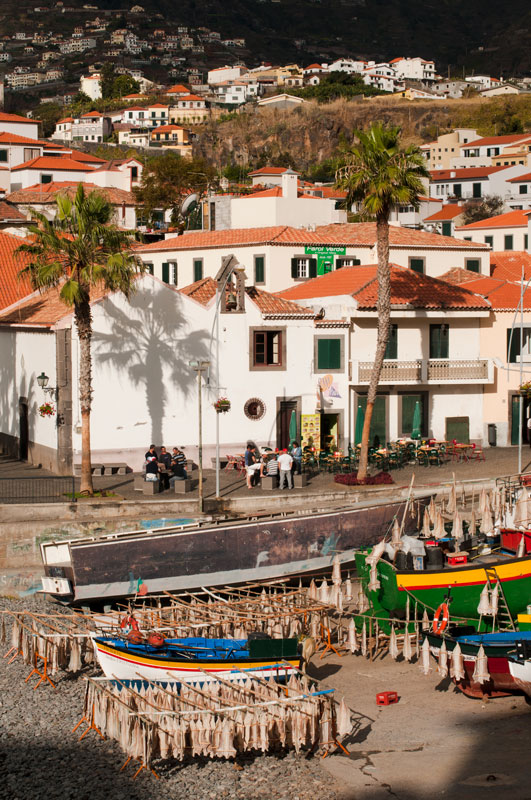
From the balcony we could see colorful fishermen's boats with drying bacalao salt cod – so at least, we thought, these actors knew what the fish looked like.


 The name of the town literally means  chamber of the wolves and its history deserves a mention too. The legend has it that the Portuguese discoverer João Gonçalves Zarco (who is credited with the discovery of the Madeira Islands) chose the location of the modern town for the very first disembarkation. He assessed the perfect natural conditions: a cliff forming and amphitheater shape that would protect ships from Atlantic storms. So Câmara de Lobos could very well be the very place where a human set his foot on Madeira.

Upon arrival Zarco and his men also found a large colony of marine animals – sea lions or lobos-marinhos (sea wolves in Portuguese). Apparently sea lions were either looking very important or were communicating so loudly, that they reminded seamen of the members of câmaramunicipal chamber. So they baptized the city with this pejorative term: Câmara de Lobos - Municipal chamber of Sea-Lions.

I would like to illustrate this part of the story with some pictures of lobos. Alas, this species of monk seals now live only in a small colony on Ilhas Desertas – uninhabited islands that are a protected Nature Reserve and constitute a part of Madeira archipelago. This is right, contrary to the popular belief Madeira is not just an island but also a part of archipelago named after its biggest island.
So even though you cannot see monk seals in Câmara de Lobos anymore, fishermen, as we found out, are more than real.
It was midday so the morning part of their job was done: nets taken out, cleaned and hung to dry, fish delivered to the market – time for some social life. And there they were: sitting on the benches on cute little plazas, they were playing dominoes, commenting the game so loudly and emotionally that we had no doubt: these fishermen were real. The hired actors would have been fired for scaring tourists away with their loud exclamations. Good thing we could not understand what exactly they were screaming at each other!


Walk along the boardwalk to snap the views of the city with agricultural terraces in the background.


Make sure you take the stairs to the upper level of boardwalk leading farther along the coast. You will be rewarded with view of Cabo Girao, one of the highest cliffs in Europe with the village of Ribeira Brava bravely climbing up its slopes.


After walking up and down the narrow streets the idea of having a fresh seafood lunch seemed more and more appealing. To our disappointment, we could not find anything. There were a couple of bars where fishermen were gulping vital energy. There were a couple of sandwich places. There was a rather modern looking restaurant that had a couple of seafood dishes advertised on the menu – not the abundance we were hoping for, and anyway it was closed. There even was a churrascaria – Brazilian Steakhose – not something we were hoping to find at fishing village…


Losing hopes and growing appetite we headed back to Churchill's pub, but it was closed, too. According to local custom, there was no sign with opening times so it could be in a couple of minutes, couple of hours or even months – till the season starts. We had no way of knowing.
As the hunger was growing we decided to return to Funchal for lunch.
From the Churchill's balcony we gave the last look to the colorful boats, white houses and drying fish of Câmara de Lobos.


Located so close to Funchal and glamorous hotels of Lido, it has somehow kept its rough charm and was not turned into another manicured resort for rich and famous. But maybe this proximity was something that actually helped this village freeze in time.  Tourist buses only stop here for half hour, crowds of tourists snap colorful shots and disappear towards other attractions. Those with money opt for the glam of comfortable modern resorts… And fishermen of Câmara de Lobos keep drying bacalao on their colorful boats, playing dominoes, shouting and drinking poncha…

Ode to simple food

What has happened, presumably in the interest of more consistent nourishment, is that individual tastes and local flavours have taken a terrible beating at the hands of mass-producers. A Third Avenue hamburger tastes exactly like Champs Elysées hamburger.  Chicken, once a bird, has been turned into a commodity along with pork,beef and lamb. And as for vegetables — when was the last time you ate a tomato, a potato or a salad that you didn't have to smother with sauce or dressing before there was any hint of flavour?
Bread like plastic, apples like wet socks, cheese with delicate complexity of a bar of cheap soap, onions with no bite, spinach that would make Popeye choke. It all looks genuine because everything from the lamb chop to the string bean is bred for appearance, but its resemblance to real food stops the moment you start to chew.
Peter Mayle. Expensive habits.


I took liberty of starting with such a long quotation because I couldn't have said it better. And mind it, this was written 20 years ago and the things did not exactly improve since.
After having spent so many contracts in States we were longing to stay for 6 month in Europe not only because of its undoubted cultural, historical and architectural treasures but also because our mouths we already watering in anticipation of fresh, unique and creative European food.


And even though we have visited quite a few places that made even traditional Russian Olivier Salad — here called ensladilla russa — look like a sophisticated dish... 


...we never lost the edge for trying simple "hole in the wall" places and simple foods. And so far — we are surprised ourselves! — – we liked pretty much everything we tasted.


In States people appreciate predictability in food: most restaurants are a part of huge franchises. So be it a burger place, seafood restaurant, Italian trattoria or Mexican cantina, one can be sure to find exactly same menu from Washington to Florida, from Maine to California. You know exactly what you are paying for and your dish will look, taste and cost exactly same, be it Alaska or Hawaii.

Europeans, on the other hand, take pride in being different. There is always a “secret ingredient” – different kind of salt, an herb, a spice, maybe sauce, method of cooking or presentation that will make difference between two same dishes served in that specific restaurant or the one next door, let alone on the other side of the country.

But there are very simple foods with only one secret ingredient: freshness.


Trundling around Teguise we were not anymore hungry after a good lunch, but wanted to extend the pleasure of being in this cute little sun-bleached town. So we landed for a snack at La Cantina.

We ordered simplest dishes: white bait and pimientos padrón – small green peppers (originally from municipality of Padrón) fried in olive oil. The food came on wooden planks and was accompanied by freshly baked bread and coarse salt.  


Another simple dish we discovered in Canaries is papas arrugadas — wrinked potatoes. Being from Belarus and Estonia we thought we knew all possible ways of cooking potatoes but the Canareños proved us wrong.  They are small potatoes (they say the yellow-fleshed Tenerife variety are best) boiled in their skins in salty water. They are then dried over a low heat untill the skins become wrinkly and is covered by salty crust. It can be a side dish served with meat or fish or simply as tapas . The dish is said to have been invented by fishermen who boiled potatoes in seawater.
Despite its seeming simplicity it is a delight to your senses and we are excited to try it when at home: we will be there in time of "young potatoes".


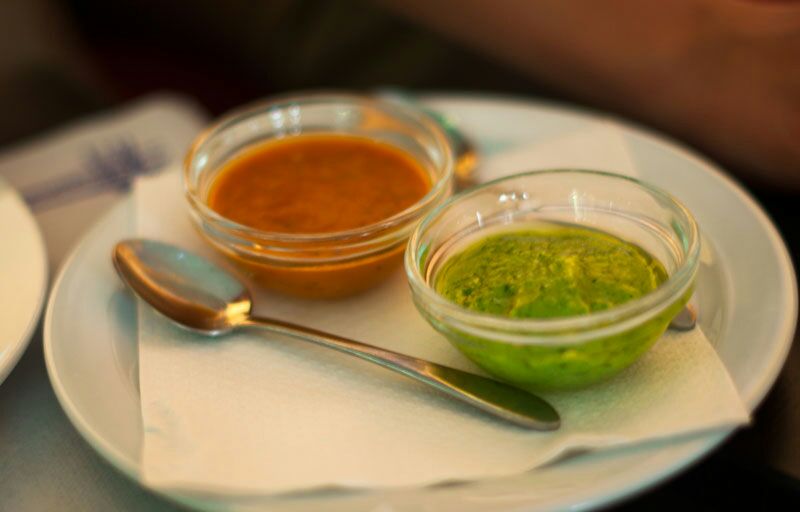
Traditionally it is served with two sauces: mojo rojo, whose basic ingredients are tomatoes, peppers and paprika (mojo picón is its spicy version and contains hot chili as well) and mojo verde — a green sauce made with oil, vinegar, garlic, coriander and parsley.  The sauces come in small bowls so you can use as much or as little as you like.


But we found another perfect addition: garlic shrimp served in sizzling oil with crunchy garlic chips.


And coming back to where we started, if you have a chance — look for one of Peter Mayle books. He is British who got fed up with fish and chips, fog and rain and moved to Provence. He lives a busy life sharing his time between wine tastings, frog tastings, escargot tastings, pastis tastings and whatever else the French are prod of. He then describes his impressions in his books and even though he covers more or less the same topic — life in Provence with all its tastes and flavours — he manages to keep us interested with his witty style, ironic observations and eagerness to learn, smell and taste more. 


More about  food and travel - here!
Published with Blogger-droid v2.0.4

Tuesday, April 17, 2012

Easter postcard from the Canaries

While others were in the church, fishermen carry on with their daily routine in Arrecife, Lanzarote, Canaries Islands

Tuesday, April 3, 2012

Teguise

One of our favorite places on Lanzarote is Teguise, the island capital until 1852. Located only about 15km from the present capital Arrecife it is well worth a visit. Stop there on your drive around the island or better go there by taxi. Renting a car will cost you around 50€ while the taxi will be less than 15€ one way. Not only will you save money but this will also give you the opportunity to enjoy some excellent Lanzarote wines.

Teguise today is a sleepy white-washed town with a handful of churches and convents...


..mountains in the background...


...quiet little plazas


...and sleepy sunny streets.


We discovered it on one of our drives around the island and could not wait to come back.

Unlike in Arrecife dominated by white walls and blue door frames, in Teguise the second main color is green...


...even though sometimes it is only white on white...


...and sometimes green turns into eye-popping turquoise...


...that makes striking contrast with orange tiled roofs.


And even though it seemed it could not get any better Teguise pleasantly surprised us once again. Lunch at La Cantina, in their inner yard — or as they call it Secret Garden — was a perfect conclusion of a perfect day. Simple fresh food on wooden boards with a generous dash of coarse sea salt served in the open air patio tasted even better than it looked. Who could think that dipping a pinch of bread in simple salt would taste so well? Pimientos Padron and grilled white bait made it one of the most memorable meals.


Published with Blogger-droid v2.0.4